Integrated Framework for Rural, Agricultural, and Infrastructure Solarisation
Introduction
Uttar Pradesh has experienced a sustained rise in electricity consumption over the last five financial years, reflecting structural expansion in residential demand, agricultural mechanisation, urbanisation, and industrial growth. Official consumption data for total energy consumption by ultimate consumers indicates a clear upward trajectory from 94,932 GWh in 2019-20 to 121,122 GWh in 2023-24. Although there was a temporary moderation during 2020-21 (93,600 GWh) due to pandemic-related disruptions, consumption recovered sharply thereafter, reaching 98,730 GWh in 2021-22 and accelerating significantly to 115,675 GWh in 2022-23 and 121,122 GWh in 2023-24.
Between 2019-20 and 2023-24, Uttar Pradesh’s year-to-year electricity consumption increased by approximately 27.6%. The most pronounced acceleration occurred between 2021-22 and 2022-23, when annual consumption rose by nearly 17%. This surge corresponds with post-pandemic economic normalization, increased agricultural pump usage, urban cooling demand, and intensified industrial operations.
Table 1: Total Energy Consumption by Ultimate Consumers in Uttar Pradesh (GWh)
Financial Year
Uttar Pradesh
India
2019-2020
94,932
1,052,346
2020-2021
93,600
1,041,656
2021-2022
98,730
1,141,485
2022-2023
115,675
1,264,103
2023-2024
121,122
1,350,092
National consumption during the same period rose from 1,052,346 GWh to 1,350,092 GWh, indicating that Uttar Pradesh’s growth broadly tracks national trends but remains structurally significant given the state’s population and economic scale.
The rise in energy consumption must also be viewed against peak demand conditions. Summer peak loads in Uttar Pradesh have increased materially in recent years due to higher air-conditioning penetration, irrigation demand during heatwaves, and expanding commercial activity. The structural nature of this increase suggests that demand growth is not episodic but embedded in the state’s development trajectory.
Industrial expansion over the past five years has materially influenced this energy demand pattern. The development of expressway-linked industrial corridors, electronics manufacturing clusters, logistics parks, food processing zones, and defence manufacturing facilities has led to increased contracted load and higher industrial energy intensity. Data centre investments and cold-chain infrastructure expansion further contribute to steady base-load demand.
The state’s industrial policy initiatives have aimed to increase manufacturing contribution to Gross State Domestic Product (GSDP), and energy consumption growth is a direct reflection of this structural shift. If current industrial expansion and infrastructure investments continue at comparable rates, electricity demand in Uttar Pradesh may reasonably be expected to cross 140-150 BU within the next three to four years, with peak demand pressures intensifying correspondingly.
In parallel with demand expansion, the 2026-27 State Budget underscores the importance of renewable integration. The agricultural allocation of ₹10,888 crore incorporates provisions for irrigation system strengthening, including solarisation under PM-KUSUM. A dedicated allocation of ₹637.84 crore has been made for PM-KUSUM implementation in 2026-27, while alternative energy allocations have increased to ₹2,104 crore to support broader renewable expansion. Solarisation of agricultural feeders and tubewells forms a core part of this policy direction, intended to reduce grid stress during irrigation cycles and moderate long-term subsidy burden.
Given the scale of rising energy requirements and the industrial acceleration underway, renewable deployment in Uttar Pradesh must be structured to serve three simultaneous objectives: reduction of fiscal subsidy pressure, mitigation of environmental externalities, and maintenance of grid stability under rising peak loads. Distributed renewable systems, feeder-level diagnostics, agricultural solarisation, and municipal infrastructure integration must therefore be aligned with projected demand growth.
For institutions such as the Global Energy Alliance for People and Planet (GEAPP), Uttar Pradesh represents a high-demand, high-growth energy environment where renewable deployment has system-level implications rather than isolated project impact. Engagement with the Uttar Pradesh State Transformation Commission (UPSTC) may therefore focus on analytical strengthening of demand forecasting, structured feeder solarisation frameworks, distributed renewable integration in industrial clusters, and financial modelling of long-term subsidy rationalisation. The scale of electricity consumption growth in Uttar Pradesh offers a context in which clean energy integration can materially influence both fiscal stability and emission outcomes.
Key Areas of Cooperation between UPSTC and GEAPP
The scale and structural transformation of Uttar Pradesh’s energy system necessitate coordinated technical, financial, and institutional efforts. The Uttar Pradesh State Transformation Commission (UPSTC), as a policy coordination body, is positioned to align sectoral strategies across energy, agriculture, industry, and urban development. Within this framework, cooperation with the Global Energy Alliance for People and Planet (GEAPP) may be structured around two primary areas: greening energy ecosystems in Uttar Pradesh and advancing clean energy-linked outcomes under the Zero Poverty agenda.
Greening Energy Ecosystems in Uttar Pradesh
The rapid rise in electricity consumption in Uttar Pradesh, combined with expanding industrial and agricultural load, requires the progressive integration of renewable energy across generation, distribution, and end-use systems. Greening the energy ecosystem entails not only increasing renewable capacity but also restructuring the way energy is generated, transmitted, consumed, and subsidised.
One area of cooperation lies in large-scale feeder solarisation, particularly for agriculture-dominated circuits. With significant agricultural feeder segregation already achieved, there is scope for systematic deployment of feeder-level solar plants that offset irrigation demand during daytime hours. Analytical support in feeder-level load modelling, renewable hosting capacity estimation, and seasonal demand mapping can enhance precision in renewable deployment and reduce grid stress.
Industrial growth corridors represent another area of focus. As new manufacturing clusters and logistics parks expand, distributed renewable systems, such as captive solar, hybrid systems combining solar and storage, and green power procurement frameworks, can reduce reliance on conventional power procurement. Technical cooperation may therefore include demand forecasting for high-growth industrial zones, structuring renewable integration models for industrial estates, and evaluating lifecycle cost implications for green power substitution.
Urban infrastructure presents a third dimension of ecosystem greening. Drinking water supply systems, sewerage treatment plants, and municipal buildings collectively represent substantial electricity loads. Renewable integration in these sectors, particularly rooftop solar and biogas recovery, reduces municipal expenditure and improves resilience. Analytical frameworks to quantify energy intensity in urban services and model potential displacement of grid electricity would contribute to structured renewable adoption.
Beyond individual sectors, greening the energy ecosystem also involves improving data systems and planning tools. Time-series demand forecasting, peak load modelling, subsidy burden analysis, and emission reduction tracking form part of a comprehensive energy transition strategy. Cooperation in analytical strengthening of these areas can enhance evidence-based planning and improve long-term fiscal sustainability.
In aggregate, greening the energy ecosystem in Uttar Pradesh implies a transition from centralized fossil-based supply to a diversified structure incorporating distributed solar, biomass, storage, and grid modernization, aligned with rising demand patterns and industrial expansion.
Zero Poverty and Clean Energy Integration
The Zero Poverty agenda in Uttar Pradesh seeks to create durable income pathways for ultra-poor households through targeted interventions in livelihoods, skilling, and asset creation. Energy access plays a foundational role in enabling productive economic activity among vulnerable households.
Cooperation in this domain may focus on linking renewable energy deployment with livelihood augmentation. Distributed solar systems, hybrid micro-systems combining solar and biomass, and energy-enabled enterprise clusters can provide reliable power for tailoring units, agro-processing equipment, food preservation systems, irrigation pumps, and small manufacturing units. Such systems move beyond basic electrification toward income-generating electricity access.
Agricultural solarisation under PM-KUSUM also intersects with Zero Poverty objectives. Solar-powered irrigation reduces operational cost burdens on small and marginal farmers while potentially enabling surplus energy export where net-metering frameworks permit. Structured financial modelling can assess how solarisation reduces long-term electricity subsidy expenditure and improves farmer income stability.
Another dimension of cooperation concerns targeted support for vulnerable groups, including women-headed households, elderly beneficiaries, and persons with disabilities. Energy-enabled livelihood packages tailored to these categories can enhance self-reliance and reduce vulnerability to income shocks.
Integration of clean energy with Zero Poverty interventions requires careful system design. Load assessment, asset selection, financing models, and monitoring mechanisms must ensure that renewable infrastructure translates into measurable income outcomes. Analytical cooperation in designing scalable livelihood-linked renewable models would strengthen the developmental impact of clean energy deployment.
Energy Access for Rural Livelihoods
Electricity access in rural Uttar Pradesh must support productive activity beyond domestic consumption. Standalone solar systems provide limited service for lighting and small appliances but are insufficient for sustained enterprise loads such as irrigation pumping, tailoring equipment, grain milling, cold storage, or food processing units.
Hybrid renewable systems combining solar photovoltaic generation with dispatchable support and storage have demonstrated improved reliability and lifecycle viability. Techno-economic assessment of solar PV-biomass-fuel cell hybrid systems indicates elimination of unmet load under optimized configurations. Hybrid PV-wind systems have similarly been evaluated for residential and distributed use cases with cost competitiveness relative to grid tariffs under appropriate conditions.
In rural Uttar Pradesh, agricultural residue availability provides an opportunity to integrate biomass gasification as a complement to solar generation. Such systems reduce battery dependence while enabling productive use of electricity during non-solar hours.
Table 2: Hybrid Configuration for Rural Livelihood Clusters
Component
Technical Role
Application in Rural Context
Solar PV
Primary daytime generation
Irrigation, tailoring, agro-processing
Biomass Gasifier
Evening baseload
Utilizes crop residue; stable supply
Battery Storage
Short-term balancing
Supports night loads and voltage stability
Smart Inverter
Load prioritization
Enterprise equipment prioritization
These configurations are suitable for village clusters or agricultural producer groups where aggregated demand justifies distributed generation.
Feeder-Level Power Sector Diagnostics
Approximately seventy percent of electricity revenue in Uttar Pradesh originates from residential consumers, and a substantial portion of supply is linked to agriculture and rural feeders. The state operates roughly twenty thousand feeders under UPPCL. Renewable integration must therefore be aligned with feeder capacity and load conditions.
Feeder-level diagnostics should include load profiling, voltage stability mapping, loss assessment, and hosting capacity estimation. Agriculture feeder segregation, already achieved in nearly eighty percent of cases, facilitates targeted solarisation of irrigation circuits.
Table 3: Framework for Feeder-Level Diagnostics
Analytical Dimension
Data Required
Expected Output
Load Profiling
Hourly and seasonal demand
Identification of peak stress periods
Technical & Commercial Loss Mapping
Feeder-wise loss data
Upgrade prioritization
Voltage Stability
Voltage fluctuation logs
Renewable hosting thresholds
Agriculture Feeder Mapping
Segregated feeder records
Solarisation planning inputs
Solarisation of Agricultural Tubewells
(a) Budgetary Provisions and Institutional Alignment
The 2026-27 Uttar Pradesh Budget provides ₹637.84 crore for PM-KUSUM implementation, with a broader alternative energy allocation of ₹2,104 crore. Within this framework, solarisation of agricultural tubewells and irrigation feeders constitutes a central component.
PM-KUSUM Component-C supports solarisation of grid-connected agriculture pumps and feeder solarisation. Uttar Pradesh has issued Letters of Agreement for approximately 1,527.2 MW of solar capacity aligned to irrigation feeder supply, with an overall target of around 2,000 MW by 2027. Approximately five thousand agriculture feeders are planned for solarisation to provide up to eight hours of assured daytime power for irrigation.
Table 4: Key Budgetary and Capacity Provisions (2026-27)
Category
Allocation/ Target
Observations
Agricultural Sector Budget
₹10,888 crore
20% increase over prior year
PM-KUSUM Allocation
₹637.84 crore
For pump and feeder solarisation
Alternative Energy Allocation
₹2,104 crore
Supports solar expansion across sectors
Solar Capacity Target (Irrigation Feeders)
~2,000 MW by 2027
Based on ongoing LoAs
Agriculture Feeder Solarisation
~5,000 feeders
Dedicated daytime irrigation supply
(b) Technical Models of Tubewell Solarisation
Tubewell solarisation in Uttar Pradesh proceeds under two principal models:
i) The first model involves installation of stand-alone solar pump systems replacing diesel or grid pumps. These systems typically range between 2 kW and 10 kW depending on irrigation load.
ii) The second model involves feeder-level solarisation wherein solar plants are installed near substations feeding dedicated agriculture circuits. Under this model, solar generation offsets feeder demand, ensuring daytime irrigation supply without requiring individual rooftop installations at every pump.
(c) Subsidy Structure and Fiscal Implications
Under PM-KUSUM guidelines, capital subsidy is typically shared between the central government, the state government, and the beneficiary farmer. While exact percentages vary by component, farmers generally contribute a limited share of total capital cost, with the remainder subsidized.
Historically, electricity subsidies for tubewells have imposed substantial fiscal pressure on the state. Solarisation reduces recurring subsidy expenditure by lowering grid power procurement for irrigation. Over time, this creates fiscal savings despite upfront capital outlay.
(d)Energy and Emission Implications
Solarisation of irrigation reduces dependence on coal-based grid electricity and diesel pumps. A 5 kW solar pump operating 1,200 hours annually can generate approximately 6,000 kWh per year. If this displaces grid electricity with average emission factor of roughly 0.8 kg CO₂ per kWh, each pump can avoid approximately 4.8 tonnes of CO₂ annually. If one million pumps are solarised, annual emission reduction may exceed 4.8 million tonnes of CO₂, subject to actual load and displacement assumptions.
(e) Farmer Income and Net Metering
In grid-connected solarisation models, surplus daytime generation may be exported under net-metering provisions where permitted. This creates potential supplementary income for farmers. Proper metering, export tariff alignment, and load balancing safeguards are required to ensure equitable outcomes.
Solarisation of Water Bodies, Reservoirs, and Canal Networks
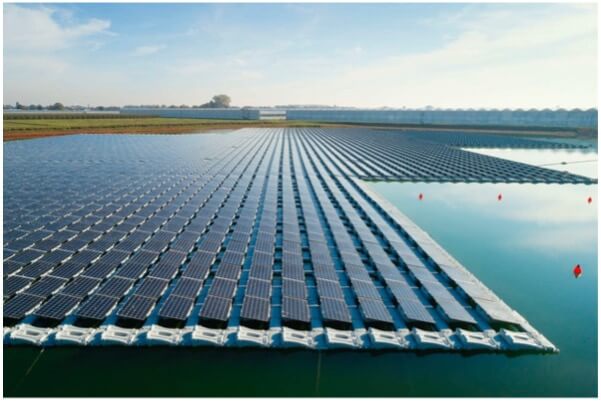
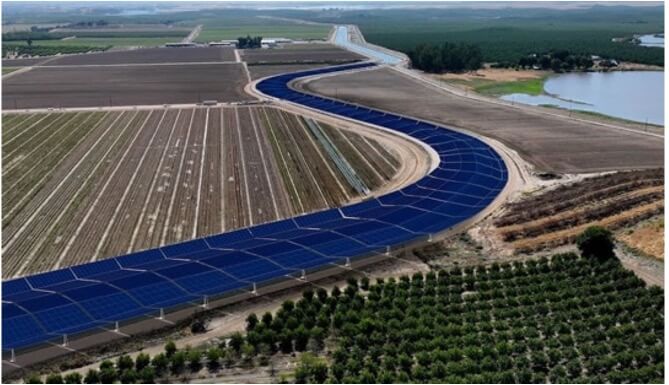
Uttar Pradesh has extensive irrigation canal systems and surface water bodies that present potential for floating and canal-top solar installations. In water-stressed regions such as Bundelkhand, evaporation losses from reservoirs and canals reduce effective water availability. Solar panel coverage over water surfaces can reduce evaporation while generating electricity.
Floating solar systems require assessment of water depth variation, anchoring feasibility, seasonal fluctuation in water levels, and proximity to substations. Canal-top installations require structural supports that do not interfere with water flow or maintenance operations. These installations reduce the need for separate land parcels and utilize public infrastructure corridors.
Technical feasibility assessment must consider sediment load, monsoon variations, and maintenance access requirements. Energy yield modelling should incorporate water-surface cooling effects, which may marginally improve panel efficiency compared to ground-mounted systems.
In regions where canal systems align with irrigation feeders, generation from canal-top systems may be directly integrated with agriculture supply circuits. Such integration requires coordination between irrigation and power departments.
Solarisation of water bodies must therefore be evaluated not as a symbolic intervention but through hydrological, structural, and grid-connection analysis.
Renewable Integration in Urban Utilities
Drinking water supply pumping stations and sewerage treatment plants constitute significant and predictable electricity loads within urban local bodies in Uttar Pradesh. Pumping systems for raw water intake, treatment, and distribution operate for extended hours daily, while sewerage treatment plants function continuously to maintain sanitation standards. Electricity expenditure in these facilities forms a substantial share of municipal operating costs, yet energy consumption is often recorded under aggregated municipal categories rather than analysed as dedicated infrastructure load. This limits targeted planning for renewable displacement.
Solar photovoltaic integration in drinking water supply systems can be undertaken through rooftop installations on treatment plants, ground-mounted systems within available campus land, or elevated structures above reservoirs. A substantial portion of pumping activity coincides with daylight hours, allowing direct self-consumption of solar generation without extensive storage requirements. Where pumping schedules extend into evening hours, battery systems may be evaluated based on load curve analysis. Integration of variable frequency drives and energy-efficient motors alongside solar deployment can further reduce baseline electricity consumption.
Sewerage treatment plants present a stable base-load profile due to continuous aeration, sludge processing, and pumping operations. Ground-mounted solar systems within plant premises can offset daytime consumption, while anaerobic digestion units offer the opportunity to capture biogas for on-site power generation. Hybrid configurations combining solar photovoltaic systems with biogas-based generators can reduce grid dependence more effectively than single-technology installations. Such systems improve resilience against grid fluctuations while lowering operating cost per unit of treated wastewater.
Effective renewable integration in urban utilities requires structured energy audits to determine installed capacity, annual consumption, operating hours, and tariff exposure for each facility. Consolidation of electricity billing data from UPPCL with infrastructure records maintained by the Urban Development Department would enable prioritization of high-consumption facilities. Targeted deployment in large municipalities where electricity intensity per kilolitre of treated water is high can produce measurable fiscal savings and emission reductions over a twenty-year asset lifecycle.
Renewable integration in drinking water and sanitation infrastructure therefore represents a technically viable and fiscally relevant intervention within the broader clean energy transition of Uttar Pradesh. By focusing on centralized infrastructure nodes with predictable demand patterns, the state can achieve meaningful renewable penetration while strengthening operational sustainability of essential public services.
Table 6: Renewable Options for Urban Utilities
Utility
Renewable Integration
Expected Impact
Drinking Water Systems
Solar PV + smart metering
Reduced grid draw
Sewerage Treatment Plants
Solar PV + biogas
Lower operating cost
Municipal Buildings
Rooftop solar
Partial self-consumption
Enabling Ecosystems
Enabling ecosystems are critical to ensuring that renewable energy deployment in Uttar Pradesh is structurally aligned with long-term demand growth, fiscal sustainability, and grid stability. Beyond capacity addition, this requires coordinated infrastructure planning, district-level load forecasting, hybrid technology evaluation, and systematic data integration across power, agriculture, irrigation, industry, and urban development departments. An integrated analytical architecture, combining feeder-level load curves, pump enumeration data, industrial demand projections, and geospatial infrastructure mapping, will strengthen planning precision, reduce curtailment and subsidy inefficiencies, and enable renewable investments to translate into measurable system-level outcomes.
Renewable corridors and Infrastructure Generation
(i)Renewable Integration Along Expressways
Uttar Pradesh has developed an extensive expressway network with wide right-of-way corridors. These corridors provide potential sites for linear solar installations. Ground-mounted solar systems along expressways can supply electricity for toll plazas, lighting systems, surveillance infrastructure, and service areas, with surplus generation fed into the grid where feasible.
Any renewable integration along expressways requires assessment of land availability within right-of-way limits, safety considerations, glare analysis for vehicle traffic, and interconnection feasibility with nearby substations. Installation design must comply with road safety standards and ensure structural resilience under high-speed wind conditions.
In addition to photovoltaic installations, the potential integration of vertical axis wind turbines (VAWT) may be examined as part of a hybrid renewable configuration. Expressways generate dynamic airflow patterns influenced by both natural wind conditions and vehicular movement. VAWT systems, which are designed to operate under multi-directional and turbulent wind conditions, may be suitable for such environments when appropriately engineered. Rather than treating wind generation as a standalone intervention, its evaluation may be undertaken as part of a hybrid PV–VAWT configuration where solar generation forms the primary energy source and wind contributes supplemental output during non-solar hours or during seasonal wind variation.
A structured technical study may be undertaken to characterize wind profiles along selected expressway stretches, including height-based wind velocity measurements and diurnal variation analysis. Such measurement exercises would not be positioned as feasibility constraints but as inputs to optimize turbine sizing, placement intervals, and hybrid system architecture. Data-driven optimization can enable right-sized turbine deployment aligned with actual wind regimes.
Hybrid PV–VAWT systems offer potential advantages in linear infrastructure settings. Solar generation provides predictable daytime output, while wind systems may generate during early morning, evening, or seasonal wind periods. When combined with battery storage, such hybrid configurations can improve load smoothing for expressway infrastructure and reduce reliance on grid-supplied power during peak hours.
From a system design perspective, expressway-based hybrid renewable corridors may be structured as distributed micro-generation zones connected to nearby substations. Lifecycle cost modelling can compare pure PV systems with PV–VAWT hybrid configurations to determine optimal technology mix based on measured wind regimes and projected generation profiles.
This approach positions expressways not only as transport corridors but as energy-generation corridors capable of hosting multi-technology renewable systems. Hybrid deployment models allow incremental scaling, where solar systems are implemented initially and wind components are integrated in stretches demonstrating favorable wind characteristics.
(ii) Solarisation of Mandis and Government Market Infrastructure
Agricultural mandis and government-operated markets represent concentrated electricity consumption nodes distributed across districts. These facilities typically operate lighting systems, grading equipment, cold storage units, weighing systems, and digital transaction infrastructure. Electricity expenditure in these facilities constitutes recurring operational cost borne by public authorities.
Solar rooftop systems installed on mandi structures can offset a portion of daytime electricity demand. Load analysis would determine the share of demand that coincides with solar generation hours. In mandis with evening operational hours, battery integration may be assessed, although cost justification must be based on actual load curves rather than assumed need.
The distributed nature of mandis allows aggregation of multiple medium-scale installations into a structured program. Technical evaluation would require roof structural assessment, shadow analysis, interconnection feasibility, and net-metering compatibility. Solarisation of mandis provides measurable energy offset without requiring additional land acquisition.
Where mandis are located in high-solar irradiance districts with stable grid interconnection, solar rooftop systems can be deployed with relatively low transmission constraints. Financial modelling should incorporate capital cost, expected annual generation, displacement of grid electricity, and maintenance cost over a twenty-year horizon.
District-Level Renewable Planning and Demand Forecasting
(i)Consumption Forecasting for Long-Term Planning
Long-term renewable infrastructure planning must be grounded in district-level electricity consumption projections. UPPCL maintains district-wise consumption data that can be analysed for historical growth trends across residential, industrial, commercial, and agricultural categories.
Projection models may be developed under multiple scenarios incorporating industrial growth rates, agricultural electrification expansion, urbanization rates, and appliance penetration trends. Twenty-year and twenty-five-year projection horizons should be considered for infrastructure planning.
Such forecasting would allow estimation of future peak demand and annual energy requirement at district scale. Renewable capacity addition can then be calibrated against projected load growth rather than solely against state-level aggregate targets. District-level forecasting also informs transmission reinforcement requirements, storage planning, and phased renewable deployment scheduling.
(ii) Solar Parks Aligned with Long-Term Demand Projections
District-level solar parks may be designed not as isolated capacity additions but as infrastructure aligned to projected twenty-five-year electricity demand growth. Current district-level consumption patterns vary significantly depending on agricultural intensity, industrial concentration, urban density, and commercial activity. Planning renewable capacity at district scale therefore requires load projection modelling based on historical UPPCL consumption data, industrial investment approvals, agricultural pump usage, and demographic growth trends.
Such parks may be sized according to projected peak demand and annual energy requirement rather than uniform allocation across districts. In districts with significant industrial expansion, capacity planning must incorporate anticipated contracted load from manufacturing clusters, warehousing facilities, cold-chain infrastructure, and emerging sectors such as data centres. In irrigation-intensive districts, daytime load from agriculture feeders must also be incorporated into sizing calculations.
Battery storage integration may be evaluated in districts with high evening peak differentials. Storage systems would not serve as universal additions but would be incorporated where load curves indicate steep post-sunset ramping or voltage fluctuation risk. The economic evaluation of storage should be undertaken through lifecycle cost modelling, comparing avoided peak power procurement with capital and maintenance expenditure.
The objective of district-level planning is to move from centrally aggregated renewable targets toward geographically differentiated renewable infrastructure that reflects district-specific demand characteristics.
Institutional Coordination and Analytical Consolidation
The planning and implementation of renewable energy interventions in Uttar Pradesh spans multiple departments and agencies, each operating within distinct administrative mandates. While this institutional diversity reflects functional specialization, it also creates structural coordination challenges when renewable energy policy requires cross-sector integration.
The current principal institutional actors in the state’s energy and renewable ecosystem include the Uttar Pradesh Power Corporation Limited (UPPCL), which manages distribution and load data; Uttar Pradesh New and Renewable Energy Development Agency (UPNEDA), which is responsible for renewable energy promotion and implementation; Invest UP, which oversees sectoral policy & coordinates industrial investment approvals; the Irrigation and Water Resources Department, which manages canal and water body infrastructure; the Department of Agriculture, which interfaces with irrigation pump usage and farmer subsidy mechanisms; and the Department of Urban Development, which oversees municipal infrastructure such as drinking water systems and sewerage treatment plants. Dept. of Rural Development and Jal Nigam
Each of these institutions maintains datasets relevant to renewable integration. However, these datasets are typically stored in department-specific formats, updated on different timelines, and structured around internal administrative needs rather than cross-sectoral planning requirements. As a result, comprehensive energy planning is constrained by fragmented information flows.
UPPCL maintains feeder-level load data, billing records, and district-wise consumption statistics. However, feeder-level historical datasets are not uniformly standardized across divisions, and real-time data integration with renewable planning agencies remains limited. While district-level consumption data is available, granular load curve information for specific sectors such as irrigation or industrial estates is often not consolidated in formats immediately usable for renewable hosting capacity modelling.
UPNEDA maintains records of installed renewable capacity, subsidy disbursement, and beneficiary-level project data under schemes such as PM-KUSUM and rooftop solar programs. However, renewable capacity deployment data is not always integrated with feeder-level grid stability data from UPPCL. This separation limits the ability to assess localized grid saturation risks or evaluate whether renewable capacity is aligned with district-level demand growth.
The Department of Agriculture holds data on registered irrigation pump sets and subsidy beneficiaries. However, pump-level data may not consistently reflect operational load profiles, seasonal usage intensity, or metering accuracy. In many cases, precise enumeration of functional tubewells, pump capacity, and electricity consumption per pump is incomplete or not updated in synchronized intervals with power distribution data. This creates difficulty in accurately estimating the fiscal impact of solarisation at scale.
The Department of Irrigation maintains mapping of canals, reservoirs, and water bodies, yet geospatial integration of these datasets with grid infrastructure maps is limited. As a result, evaluation of canal-top solar potential or floating solar feasibility requires ad hoc coordination rather than systematic spatial planning.
Invest UP tracks industrial investment approvals and planned industrial clusters. However, projected electricity demand from approved industrial units is not consistently integrated into long-term load forecasting exercises conducted by distribution planners. This results in reactive rather than anticipatory grid strengthening and renewable allocation decisions.
At the municipal level, drinking water supply systems and sewerage treatment plants are managed by urban local bodies and associated agencies. Electricity consumption in these facilities is often recorded as aggregated municipal load rather than categorized infrastructure demand. In some instances, electricity consumption in public water supply systems is not fully reconciled in loss accounting frameworks, reducing transparency in subsidy burden assessment.
These structural data gaps create several handicaps at the policy level. First, renewable capacity addition decisions may not fully account for feeder-level saturation thresholds, leading to potential curtailment or voltage instability in high-penetration zones.
Second, agricultural solarisation targets may be set without precise alignment to actual pump usage intensity, seasonal irrigation demand, or district-level groundwater dependency. Without accurate pump enumeration and load profiling, capital allocation risks either under-sizing or over-sizing solar systems.
Third, subsidy rationalisation efforts require accurate baseline consumption data. Where electricity subsidy records, pump-level metering, and actual load curves are not harmonised, fiscal impact projections become imprecise. This limits the state’s ability to model long-term savings from solarisation interventions.
Fourth, industrial load forecasting is often performed at aggregate level without district-specific integration of approved projects. In rapidly expanding corridors, delayed grid reinforcement may occur because demand projections did not incorporate timely industrial data.
Fifth, the absence of integrated geospatial datasets combining grid infrastructure, irrigation canals, industrial clusters, and renewable resource potential constrains the ability to identify optimal renewable deployment sites.
These coordination and data fragmentation challenges do not arise from absence of institutional capacity, but from lack of a unified analytical framework that integrates datasets across departments. Policy interventions at the state level are therefore sometimes constrained by incomplete information, inconsistent data periodicity, or absence of standardized reporting formats.
Addressing these constraints requires the development of an integrated data architecture anchored at the state level. Such an architecture would not replace departmental systems but would consolidate critical variables for cross-sector renewable planning. Key elements would include feeder-level historical load curves, district-wise consumption growth rates, pump-level enumeration and metering data, industrial approval-linked load projections, and geospatial overlays of canal and infrastructure assets.
Standardization of reporting intervals and harmonization of sectoral datasets would improve forecasting accuracy and reduce uncertainty in renewable deployment decisions. Without such coordination, policy formulation risks being reactive, relying on aggregated state-level averages rather than granular district-specific evidence.
Institutional coordination in this context therefore refers to systematic data integration, synchronized planning cycles, and structured information sharing across energy, agriculture, irrigation, industrial development, and urban infrastructure departments. Strengthening this coordination reduces planning uncertainty, improves capital allocation efficiency, and enhances the credibility of long-term renewable transition frameworks.